
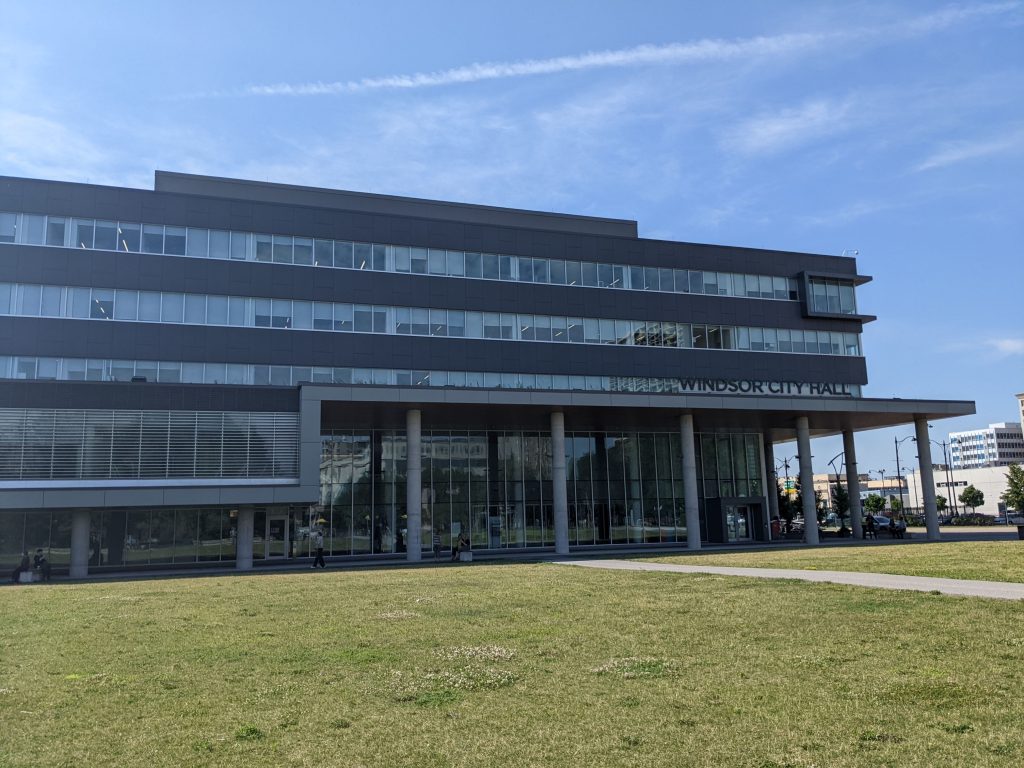
For March 2024, the Rose City Politics panel (with two new panelists) opines on the City of Windsor’s budget passing with another year of record spending on roads, sewers, and other infrastructure.
Although fresh road surfaces and new playgrounds are coming, the panel wanted to take this time to reflect on spaces that aren’t going to be fixed up this year, Windsor’s derelict spaces.
Frazier Fathers
To be fair, most Windsor’s eyesores and derelict spaces are not City owned.
Vacant lots along major thoroughfares; boarded up homes in West Windsor; poorly lit parking lots in the city core; closed schools waiting to be repurposed or sold. These spaces, coupled with the plethora of crises facing our community (housing, affordability, mental health, and addition etc.) create visual and visceral challenges in changing perceptions that no fresh pavement or playground can combat.
The recent painting of a boarded-up house on Ouellette Avenue, spearheaded by Councillor Renaldo Agostino, along with the pop-up volleyball court on another vacant lot a block away, shows how small things can hopefully make an impact. Unfortunately, we need all levels of the city to tackle these bigger challenges and the budget didn’t do that.
Last year, we saw in Leamington when the town purchased the former high school, it set a requirement around affordability and attainability of housing as a condition of any sale to a developer.
The result will be a third of the new units being attainably priced and a mix of small apartments, townhomes, and semi-detached properties. Habitat for Humanity and the Bridge Youth Resource Centre both are partnered on the project with the developer and municipality.
In Chatham, the Opportunity Villages Community Land Trust (OVCLT) is developing a life-lease community, at accessible pricing below current market value in the area.
The municipality supported this innovative development and it has won high praise, making it to the finals in the Future Ground Prize, a David Suzuki Foundation award.
They currently have an expression of interest open for individuals to apply to buy a unit in this community. This is happening in the downtown of Chatham on vacant land near the Thames River.
More recently, while we debated quadplexes, the City of London is leveraging the Housing Accelerator Funding from the Federal Government, and is launching a parking lot transformation program to encourage housing to be built on downtown parking lots. Incentives to parking lot owners to build and build now!
We will have to fund a program like this out of our tax base if we have the courage to do it!
The Barn, the Grace site, HMCS Hunter on Ouellette, several former schools, boarded up houses across the city, or the February 26 presentation to Council to sell 25+ residential lots, are all examples of where we could have been bold, made the budget innovative, and taken steps to tackle our perception and physical challenges.
Instead, we choose to let these spaces continue to sit, vacant and derelict, and hope someone else will buy them and clean up the mess, a missed opportunity to kick-start a better Windsor for everyone.
Frazier Fathers is a Lead Consultant with Community Policy Solutions. You can read his blog at GingerPolitics.com and on Rose City Politics as a panelist.

Kristen Siapas
Looking over this year’s budget offers little in terms of surprises.
There are disappointments and frustrations, perhaps, if your daily commute involves public transit (fares are outpacing inflation with a 10% rate hike), or if you were hoping to see investment in an expansion of the Arts, Culture and Heritage Fund grants (another budget has come and gone without seeing the desperately needed operational funding that will help our arts industry grow and sustain itself). But, predictably, we’re seeing an unimaginative budget that forces us to tighten our belts yet again, limiting us to the bare bones that leave some Windsorites wanting more bang for their buck.
Those who dream of adaptive reuse and renovation of publicly owned spaces, like the former Windsor Arena, the still-empty Grace Hospital site, the old W.D. Lowe High School on Giles, the Children’s Aid Society building on Cataraqui, and others scattered across our city, will also find themselves coming up empty-handed, as there aren’t any projects announced at this time that will significantly impact those neighbourhoods.
Each of these spaces represents a historic investment in the neighbourhood that once served as an anchor for the neighbouring community and helped to contribute to the type of vibrant walkable space that is desirable in this urban environment.
We have past examples of buildings like these that have been adapted for housing, in places like St. Genevieve Place Lofts (the converted St. Genevieve Catholic Elementary School) or Edith Cavell Public School in Riverside.
In these challenging times, it’s something that everyone can agree on — we are desperate for that kind of adaptive reuse wherever we can find it.
The housing crisis is a war waged on many fronts, and we need to use every strategy we have to address the problem. The City would do well to aggressively seek out developers, government programs, and partnerships that will take buildings like Lowe and turn them into affordable, accessible housing units.
There is one area, however, where we did see a small win for a group of engaged residents demanding investment in a derelict space, and that is the Jackson Park band shell.
After approving the initial feasibility study at around $120,000, administration recently came back to council with a request to more than double the cost of the study to $300,000, which was turned down during this budget.
Council did approve administration to go ahead with the initial study cost, and when council receives the report, we will see a whole new wave of advocates come to the microphone and remind us of the significance of the unique building to Windsor’s history, to the culture of the Black community, and as a performance and presentation space that can be used year-round.
Looking toward the future, we have to hope that some of these spaces will find meaningful use and positively impact their respective neighbourhoods as they once did.
It requires us to approach these spaces with a sense of imagination and a goal of creating the vibrant, walkable, connected neighbourhoods that serve not only to support residents, but also to attract growth and investment.
Kristen Siapas is an avid theatre practitioner, engaged parent, community activist, and regular panelist on Rose City Politics. You can find her at the School of Dramatic Art’s University Players at the University of Windsor.

Melinda Munro
If I received a report that 35% of my house was in fair to very poor condition, I would be, understandably, horrified.
If it said that 55% of my house was fair to very poor, I would probably be in receipt of more than a few bylaw complaints.
In 2019, the City of Windsor produced an Asset Management Plan which indicated that 35% of all assets (parks, buildings, roads, sewers) were in fair condition or worse.
But not all assets are treated equally.
Only 20% of roads were near the end of their lives, but 55% of transit assets were below fair condition.
We are five years on and undoubtedly matters are worse. The Mayor as much as admitted it during the budget debate recently.
“You can’t tax the property tax base enough to pay for the existing shortfall,” said the city engineer in response to questions from Council. The Mayor added: “The roads deficit was half a billion a few years ago and it’s probably more now.”
Recently, the City debated spending money to save an historic band shell that had been left to rot during the 15 years of municipal austerity budgets. The same council that approved the multi-million dollar “trolley-mahal” on the Riverfront almost decided to let the rot continue.
Why preserve a place with real living memory when you can put a trolley car in a glass house as a monument to a transit system that the same council is permitting to rot before our very eyes?
The Mayor and the city engineer are right. You can’t tax the 2024 taxpayers all at once for the $6.1 billion infrastructure deficit, but the piper eventually demands her money.
So, what should have happened before now was that the City should have taxed the 2000 – 2023 tax bases properly, along with using strategic debt to bring in the taxpayers between 2024 and 2054.
If they spread that deficit over 50 years of tax bases, we see a very different result.
Much like business owners use debt to fund new facilities and home owners use debt to replace the roof before it fails, not after all their furniture is drenched.
Perhaps it’s time to elect some councillors who know a little something about money rather than nothing at all about economics.
Melinda Munro is a Windsor consultant who works with local governments and not for profits on strategy and service excellence.
This article first appeared on Biz X Magazine.
 rcpwindsor.ca